പേജുകള്‍‌

Saturday, December 01, 2012

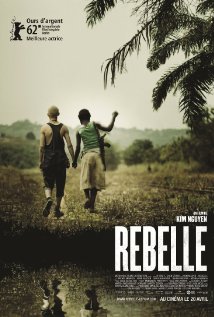
War Witch (2012)

War Witch (2012)
Director:Kim Nguyen
Country: Canada
Runtime: 90 min

Writer/director Kim Nguyen highlights the tragic plight of child soldiers in sub-Saharan Africa with this tale of a pregnant 14 year old girl recalling the time she was forced to kill her own parents and join the rebel army. Komona was just 12 when the rebels ransacked her village, and ordered her to slay her parents. Subsequently taken to the rebel camp and given an AK 47, Komona was beaten mercilessly by the rebel leader for showing weakness, and became the supreme leader's war witch after emerging the sole survivor in a bloody battle against the government army. Amidst all of this darkness, the one light in Komona's life is Magician, a 15 year old boy who shows her compassion in a world of cruelty. For a brief moment, it appears as if Komona and Magician have escaped the war, but their greatest battle has yet to be fought. Later, pregnant and haunted by the ghosts of her parents, Komona embarks on a trip back to her birthplace to make amends with her past, and ensure that her unborn child has a chance to live a life free from the sins of the mother. ~ Jason Buchanan, Rovi

Friday, November 30, 2012

Laurence Anyways (2012)

Laurence Anyways (2012)
Director: Xavier Dolan
Country: Canada | France
Runtime: 2 hours, 48 minutes


Laurence, a young french teacher and soon-to-be-published author, enjoys an intense and mutually loving relationship with his fiancé, Fred. But on the day after his 30th birthday, Laurence confesses to Fred that he longs to become a woman, asking her to support him in this transformation. Despite her best efforts, Fred is too hurt by this development, and they break up. Each of them tries to build a new life, without thinking of the past. Five years later, Laurence sends a copy of his first book of poetry to Fred.

Pieta (2012)

Pieta (2012)
Director: Ki-duk Kim
Country: South Korea
Runtime:104 minutes

Hired by a loan shark for the payment of debts from customers late, Kang-do behave like a butcher, horribly maiming his victims and spreading death. Until it shows up at his door a woman who says she is the mother and the blame for every crime, regretted having abandoned at birth and left to grow up without love. After it has been subjected to the most terrible trials to make sure he's telling the truth, Kang-do finally accepts the woman, but the fear of losing puts it, for retaliation, in a position to check in which he always kept his victims.
The life, death, money. Kim Ki-duk is a term too, an intruder fatal. The pity is not a trilogy but a sacred figure, which includes only two actants. The money should not have a place in these areas, but has acquired, and is a fallacy that demand justice, or rather, an executioner.
There is no doubt that Mercy is a film about the disproportion. He says in one fell swoop (eye) the image of the lead couple: a giant boy and a little lady, and it confirms that every scene, every nuance. The cruelties of Kang-do is beyond measure, as well as the stupidity of some debtors. I am the endurance of one, the ingenuity of the other, the architecture of revenge. They are, therefore, the decisions in the story and direction: the sex scenes admittedly excessive, the musical emphasis, the use of an actress, Cho Min-soo, the skill out of the ordinary.
Yet, one can not help but feel a overconfidence by the South Korean director, a display of self, which sometimes takes strength to what is happening within the frame, or simply prevents to surprise us. It is a kind, this, that Kim has already ridden and which excels in, but not more enchants. If it were not for the massive amount of irony that has fallen into this eighteenth film, probably more than in any other previous work, the risk would be that of preaching morality to overlap somewhat, as is the kyrie eleison final. "Lord, have mercy."
Saved by irony, Kim gives then, after all, a movie circumscribed and high, partly inspired by his countryman Park Chan-wook, but intimate and dirty, less lyrical and more rooted in the "passions" of this dark time.

Tuesday, November 27, 2012

The Orator (2011)

The Orator (2011)
Director: Tusi Tamasese
Country: New Zealand | Samoa
Runtime: 110 min


In a Samoan village, a dwarf with legitimate claims to chiefdom lives an unhappy life of ridicule with his wife, who was banished from her own village at a young age, and his pregnant step-daughter. When his wife dies, a conflict arises over the proper arrangements for her burial.

The Orator (O Le Tulafale) is a contemporary drama about courage, forgiveness and love.  Small in stature and humble, Saili lives a simple life with his beloved wife and daughter in an isolated, traditional village in the islands of Samoa.  Forced to protect his land and family, Saili must face his fears and seek the right to speak up for those he loves.

Thursday, November 22, 2012

Beasts of the Southern Wild (2012)

Beasts of the Southern Wild (2012)
Director: Benh Zeitlin
Country: USA
Runtime: 93 min


In a forgotten but defiant bayou community cut off from the rest of the world by a sprawling levee, a six-year-old girl exists on the brink of orphanhood. Buoyed by her childish optimism and extraordinary imagination, she believes that the natural world is in balance with the universe until a fierce storm changes her reality. Desperate to repair the structure of her world in order to save her ailing father and sinking home, this tiny hero must learn to survive unstoppable catastrophes of epic proportions.

Wednesday, November 21, 2012

Outbound (2010)

Outbound (2010)
Director: Bogdan George Apetri
Country: Romania
Runtime:87 min

IMDB Review:
Author: Chris Knipp (Berkeley, California)

Romanian director Apetri's powerful Outbound has some of the tragic intensity, at least in its ending, of De Sica's Bicycle Thief or René Clément's Forbidden Games. First-timer Apetri, aided on the screenplay by a trio of experienced writers, has made one of the best films to come out of the new Romanian cinema. It takes place when a woman prisoner who's served two years of a five-year sentence gets a one-day pass to attend her mother's funeral. She has no intention of turning herself back in. Her day is a chronicle of desperation and hope, beginning with her brother and ending with a doomed train ride. Whatever the crime was, it seems the sullen-faced Matilda (Ana Ularu) wasn't the perpetrator but instead has taken the hit for Paul, the father of her 8-year-old son Toma and a thoroughly sleazy character. Matilda and Paul made a deal, but just see if she can hold him to it. But she has other scores to settle and hard knocks to take.

The Romanians show a penchant for methodical real-time intensity and Apetri is no different, though a key to the power here is a willingness to elide unnecessary details, even maintain a degree of mystery, in the interest of focusing, as the great Italians did, on a few powerful scenes. Even if Matilda is out of jail and some key scenes are enacted in a wide, desolate open space designated by the original title, Periferic, she still seems to have the bars around her, holding her in the claustrophobia of a life that went wrong early. The actress, with a face as simple as a boy's, has a fixed, sullen glare that sticks in your mind.

The narrative is in three parts focused on three names: Andri, Paul, and Toma. We find out very vividly who they are. In a prologue Matilda (Ana Ularu) leaves prison on a 24-hour pass to attend her mother's funeral. Right outside the gate she meets up with a fat trucker (Ion Sapdaru) in a sleeveless shirt: it's summer, and everybody is sweaty. Her plan is to collect money to pay this man later to drive her to the port of Constanta, where she will catch a ship to smuggle her out of the country.

The first stop is Andri (Andi Vasluianu), Matilda's handsome brother. He's not pleased to see her, though he can't entirely hide fraternal feeling. She has disgraced the family, and also ill used him. His wife Lavinia (Ioana Flora) is even more openly hostile. Nonetheless they reluctantly take her to the funeral, and in that ride we feel Matilda's determination and toughness. Lavinia's insults only make her smile. She ingratiates herself with no one, smoking a cigarette outside the cemetery and walking away from the table at the al fresco dinner afterward. Andri is shocked, maybe pleased, to learn he has an 8-year-old nephew, but he's not willing to take Matilda's son in, and Matilda leaves.

The next meeting is with the abusive, self-indulgent Paul. He will give Matilda only a fraction of the payoff, saying it's not due till five years are up. He has brutal sex with her, then reveals that their son, Toma (Timotei Duma), whom he was supposed to be caring for, is in an orphanage. So that becomes an additional stop before the truck ride to the ship, and it turns into a train ride, with more brutal surprises and the shattering finale, which yet has a poetic rightness about it.

The tight schedule Matilda must follow -- she has to meet the trucker by evening and must escape before the prison knows she's missing -- heightens all the action, but Apetri's directing never feels rushed and makes every minute count. Ularu may seem one-note at times, but her unwavering drive is the key to Outbound's urgency.

Cristian Mungiu of 4 Months, 3 Weeks and 2 Days co-wrote the original story. Marius Panduru of Police, Adjective did the warm, brown-tinged photography.

Outbound has shown at Locarno, Warsaw and Toronto. Seen and reviewed as part of New Directors, New Films, the series co-presented by the Film Society of Lincoln Center and the Museum of Modern Art, New York, from March 23 through April 3, 2011.
 

Tuesday, November 20, 2012

Clip (2012)

Clip (2012)
 Director: Maja Milos
Country: Serbia
Runtime: 1 hour, 38 minutes
 
Clip is not another ‘coming-of-age’ story about the complexities of adolescence. Miloš has made an honest and non-judgmental portrait of teenagers caught in sexual and social turmoil. Sexually explicit and emotionally disturbing, it goes beyond borders and even further. Jasna is a beautiful girl in her mid-teens. Disillusioned by her life in a remote Serbian town with a dispirited mother and terminally ill father, she opposes everyone, including herself, and goes wild, experimenting with sex, drugs and simply killing time. But gradually, this desperate protest helps her come to terms with painful reality. In her first feature, Maja Miloš (1983) explores the disturbing state of adolescence as bravely and honestly as her protagonist explores herself. Isidora Simijonovic, also a debutant, gives a striking and fearless performance full of contrasts. Together they create a highly dynamic and vibrant portrait of wasted youth lost in the search for identity. Miloš sets this ‘classical’ coming-of-age story in the world of contemporary teenagers obsessed with pornographic images, virtual reality and soft violence, meanwhile exploring the blurring boundaries between sex and affection, simple pleasures and true love, brutality and tenderness. Above all, Clip examines the shifting family and social values in present-day Serbia, where the generation gaps are extreme, placing everyone between disintegrating traditions and uncertain contemporary morality.

Sunday, November 18, 2012

The Taste of Money (2012)

The Taste of Money (2012)
Director: Sang-soo Im
Country: South Korea
Runtime: 115 min


Young-jak who is a private secretary of madam BAEK, the center power of Korean conglomerate, deals with immoral private issues of her wealthy family. As his desire for money and power grows, he endures whatever he’s ordered to do and letting people around him get hurt is not a concern for him. Meanwhile, Young-jak reports to madam BAEK that madam BAEK’s husband, Mr. YOON is having an affair with a Filipino nanny, Eva. Madam BAEK is now despaired, then greedily seducing Young-jak for her sexual desire.
On the other hand, he begins to feel conflicted by madam BAEK’s daughter, the only family member who approaches him with the true heart. Lost between his morality and shortcut to successful life, he has to make the biggest decision he’s ever made to choose whom he will hang on to, in order to survive in this harsh world.

Thursday, November 15, 2012

Corpo celeste (2011)

Corpo celeste (2011)
Director: Alice Rohrwacher
Country: Italy
Runtime: 100 min 


13 year old Marta who is struggling to resettle to the south of Italy after ten years growing up in Switzerland. Bright-eyed and restless, she observes the sights, sounds and smells of the city but feels very much an outsider. Marta is about to undergo the rite of confirmation and she takes catechism but confronts the morality of the local Catholic community. From experiencing her period to making a bold decision to cut her hair, Marta begins to shape her own life for the first time since moving back to Italy.

Detachment (2011)

Detachment (2011)
Director: Tony Kaye
Country: USA
Runtime: